
Studio News — 15 July 2026
Best Bathroom Tile Sizes for a Modern Remodel | Designer Guide
What tile size is best for a modern bathroom? Compare 12x24, 24x48, large-format tile, shower mosaics and porcelain slabs in this designer guide.
Best Bathroom Tile Sizes for a Modern Remodel
A designer’s guide to choosing the right tile proportions for floors, shower walls, niches, and bathroom details.
Tile size has a much bigger impact on a bathroom than most homeowners expect.
The same stone-look porcelain can feel clean and architectural in a large format, traditional in a smaller format, or highly decorative as a mosaic.
For a modern bathroom remodel, the goal is not simply to choose the largest tile available. The right tile size should respond to the scale of the room, shower configuration, drainage, wall proportions, and overall design direction.
Here are some of the tile sizes we most often consider when designing contemporary bathrooms.
24 × 48 Inch Tile
Best For:
- Main bathroom floors
- Large shower walls
- Primary bathrooms
- Modern minimalist spaces
- Stone-look porcelain
24 × 48 inches is one of the strongest choices for a contemporary bathroom.
The larger format reduces the number of grout joints and creates a more continuous surface, especially when using marble-look or natural-stone-look porcelain.
On shower walls, 24 × 48 tile can create a highly refined architectural effect when the layout is carefully planned around niches, plumbing fixtures, benches, and glass.
Why We Like It
- Fewer grout lines
- Cleaner appearance
- Makes stone patterns feel more continuous
- Works beautifully with modern vanities
- Can visually enlarge a bathroom
The key is planning the layout before installation begins.
Large-format tile should not simply be centered on a wall without considering where cuts will land around niches, valves, benches, or door openings.
12 × 24 Inch Tile
Best For:
- Small and medium bathrooms
- Shower walls
- Bathroom floors
- Guest bathrooms
- Remodels requiring flexibility
12 × 24 remains one of the most versatile bathroom tile sizes.
It provides a modern appearance while being easier to work with in smaller rooms and complicated layouts.
It can be installed:
- Horizontally
- Vertically
- Stacked
- Offset
- In selected patterns
For a more contemporary look, we often prefer a clean stacked installation rather than a traditional staggered brick pattern.
A vertical layout can also help emphasize ceiling height.
24 × 24 Inch Tile
Best For:
- Bathroom floors
- Square rooms
- Minimal contemporary interiors
- Concrete-look or limestone-look porcelain
Square large-format tile can give a bathroom a calm, balanced feeling.
A 24 × 24 tile works particularly well when the room geometry is already relatively clean and symmetrical.
The larger square format can also work beautifully with floating vanities and frameless shower glass.
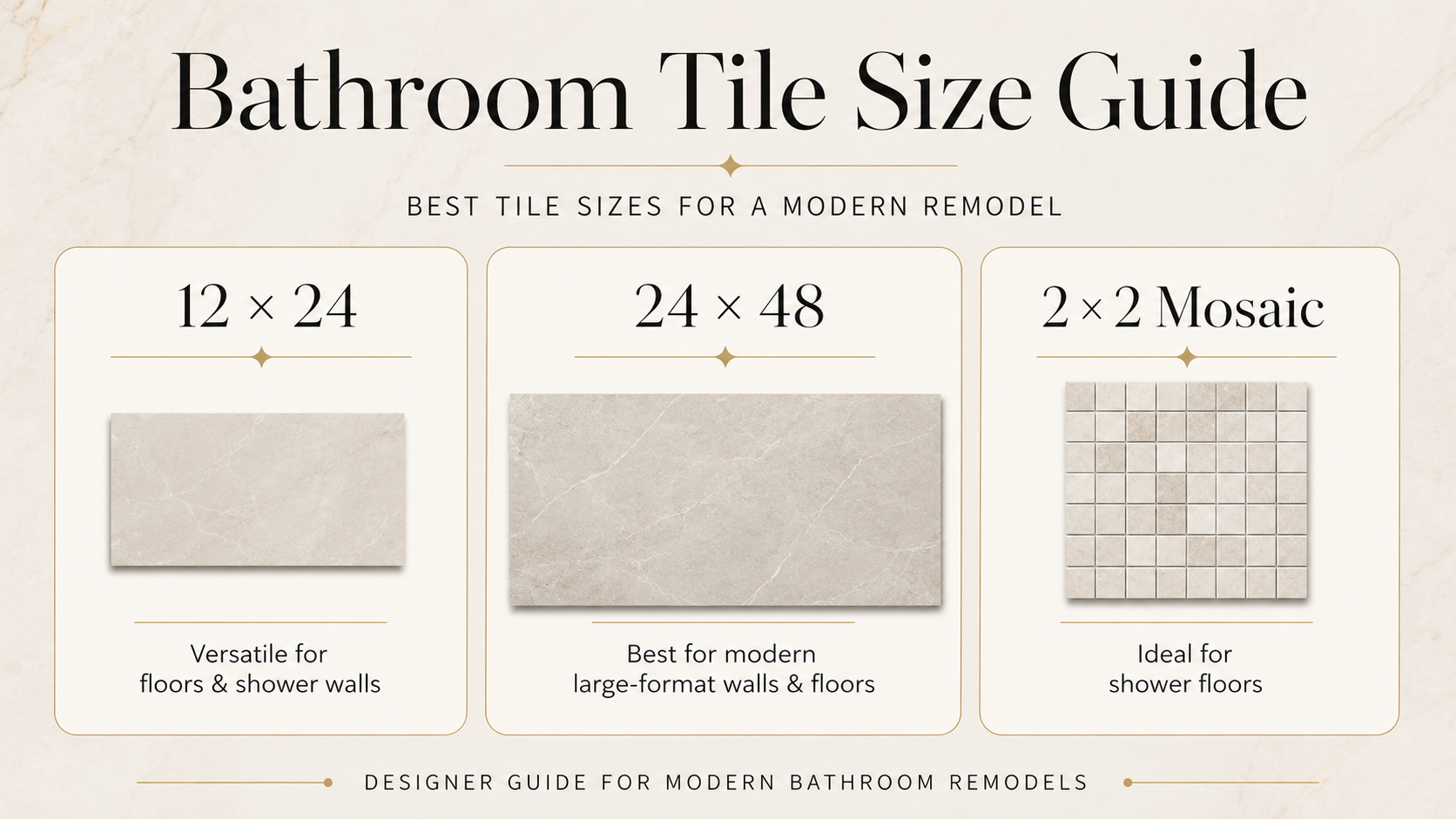
24 × 36 and 24 × 48 Tile
These elongated large-format proportions are especially effective on shower walls.
They create longer visual lines and are ideal for bathrooms where we want the material itself to feel more architectural.
When using stone-look porcelain, a larger format also allows more of the printed veining or movement to be visible.
What About Extra-Large Tile?
36 × 36, 48 × 48 and Larger
Extra-large-format porcelain can create an exceptionally clean and luxurious bathroom.
Best For:
- Large primary bathrooms
- Open wet rooms
- Minimalist architecture
- Luxury remodels
- Large uninterrupted walls
The advantage is obvious:
very few grout lines.
However, larger tile requires:
- Very flat walls and floors
- Experienced installers
- Careful handling
- Proper setting materials
- Detailed layout planning
The larger the tile, the less forgiving the substrate becomes.
For that reason, installation quality becomes just as important as the tile selection itself.
Porcelain Slabs
For a very high-end modern bathroom, oversized porcelain slabs can create a nearly seamless appearance.
They are particularly striking on:
- Shower walls
- Feature walls
- Tub surrounds
- Vanity backsplashes
Slabs can mimic marble and natural stone while dramatically reducing grout lines.
They can be beautiful, but fabrication and installation require specialized expertise and should be considered early in the design process.
What Tile Size Is Best for a Shower Floor?
This is where smaller is often better.
A shower floor needs to slope properly toward the drain.
Small-format tile allows the installer to create that slope while maintaining consistent contact with the substrate.
Common Shower Floor Sizes
2 × 2 Mosaic
One of the most practical options.
It provides:
- More grout joints for traction
- Flexibility around slope
- Easier installation around drains
1 × 1 Mosaic
Useful for curved or highly sloped shower floors and detailed designs.
Small Hexagon Mosaic
A good choice when you want more visual character while maintaining the benefits of a small-format tile.
Can Large Tile Be Used on a Shower Floor?
Yes—but the drainage system and shower design must support it.
A traditional center drain usually requires multiple planes sloping toward one point, which can make very large tiles difficult to install without awkward cuts.
A linear drain can make larger-format shower floor tile much easier because the floor can often slope in one primary direction.
This needs to be coordinated during design—not decided after construction has already started.
Best Tile Size for Shower Walls
For most contemporary projects, we frequently consider:
12 × 24
24 × 36
24 × 48
If the room supports it, 24 × 48 often produces the most elevated modern look.
For a smaller bathroom, 12 × 24 may provide better proportions and easier alignment with other architectural elements.
Should Shower Wall and Bathroom Floor Tile Match?
They can, but they do not have to.
Using the same large-format tile on both the bathroom floor and shower walls can create a quiet, monolithic effect.
For example:
Bathroom Floor: 24 × 48 limestone-look porcelain
Shower Walls: Same 24 × 48 porcelain
Shower Floor: Coordinating 2 × 2 mosaic
This creates continuity while allowing the shower floor to perform properly.
Another approach is to use a quieter floor tile and introduce a more expressive material or texture on the shower walls.
Best Tile Size for a Small Bathroom
There is a common misconception that small bathrooms require small tile.
They do not.
Large-format tile can actually make a small bathroom feel calmer because fewer grout lines visually divide the space.
For many small bathrooms, we like:
Floor
12 × 24 or 24 × 24
Shower Walls
12 × 24 or 24 × 48
Shower Floor
2 × 2 mosaic
The deciding factor should be the room geometry and the resulting tile cuts—not simply the square footage.
Best Tile Size for a Large Primary Bathroom
A larger bathroom gives us more freedom to use oversized material.
A contemporary primary bathroom may use:
Main Floor
24 × 48
Shower Walls
24 × 48 or larger
Shower Floor
2 × 2 mosaic or large-format tile with a properly designed linear drain
Feature Wall
Porcelain slab or oversized stone-look tile
Larger rooms generally benefit from larger material because the scale feels proportionate to the architecture.
Don't Forget the Grout Joint
Tile size is only part of the design.
The grout joint can dramatically change the final appearance.
A grout color close to the tile color creates a quieter and more continuous surface.
A contrasting grout emphasizes every tile and creates a much stronger grid.
For modern interiors, we typically prefer the grout to support the material rather than compete with it.
Rectified Tile for a Cleaner Look
Many modern porcelain tiles are rectified, meaning the tile edges have been precisely cut after firing.
This allows for more controlled joints and a cleaner visual appearance.
However, the appropriate grout joint still depends on:
- Tile manufacturer recommendations
- Tile variation
- Installation conditions
- Substrate
- Applicable installation standards
Very tight grout joints should never be assumed simply because a tile is large.
Think About Tile Layout Before Ordering
One of the most important steps in bathroom design happens before the installer starts setting tile.
We review how the tile will interact with:
- Shower niches
- Plumbing valves
- Shower heads
- Benches
- Vanities
- Mirrors
- Windows
- Doorways
- Glass panels
- Floor transitions
A beautiful tile can still produce a disappointing result if the layout creates unnecessary slivers or awkward cuts.
Whenever possible, tile dimensions should be coordinated with the architecture before construction reaches the installation stage.
Our Favorite Modern Bathroom Combination
For a clean contemporary bathroom, one of our favorite combinations is:
Main Floor: 24 × 48 porcelain
Shower Walls: 24 × 48 porcelain
Shower Floor: 2 × 2 coordinating mosaic
Niche: Same wall tile or a carefully selected accent material
Edges: Minimal profile or properly detailed finished edge
The result is quiet, architectural, and timeless.
Choosing the Right Tile for Your Remodel
There is no single tile size that works for every bathroom.
The best choice depends on:
- Room dimensions
- Ceiling height
- Shower size
- Drain location
- Material
- Pattern
- Existing conditions
- Desired aesthetic
- Installation complexity
A successful bathroom is created by treating the tile as part of the architecture—not simply as a finish selected at the end.
At VIKO Design Studio, we coordinate tile size, material, layout, fixtures, niches, cabinetry, lighting, and architectural details together so the finished bathroom feels intentional from every angle.
Planning a bathroom remodel in the Bay Area?
Book a consultation with VIKO Design Studio to discuss your bathroom layout, materials, and design direction.
Frequently Asked Questions
Is 12 × 24 tile still modern?
Yes. 12 × 24 tile remains a versatile contemporary option, especially when installed in a clean stacked or vertical layout.
Does large tile make a small bathroom look bigger?
It can. Fewer grout lines can make the surfaces feel less visually divided and create a calmer sense of space.
What is the best shower floor tile size?
Small mosaics such as 2 × 2 are commonly used because they accommodate shower slope effectively and provide additional grout joints underfoot.
Is 24 × 48 tile too large for a small bathroom?
Not necessarily. The important question is how the tile fits the room and where the cuts will occur. A carefully planned 24 × 48 layout can look excellent even in a smaller bathroom.
Can I use the same tile on the bathroom floor and shower wall?
Yes. Using the same material can create a highly cohesive modern look, while a coordinating mosaic can be used on the shower floor where smaller pieces are more practical.

Next Entry
Bathroom Remodel Cost in the Bay Area | 2026 Guide →